
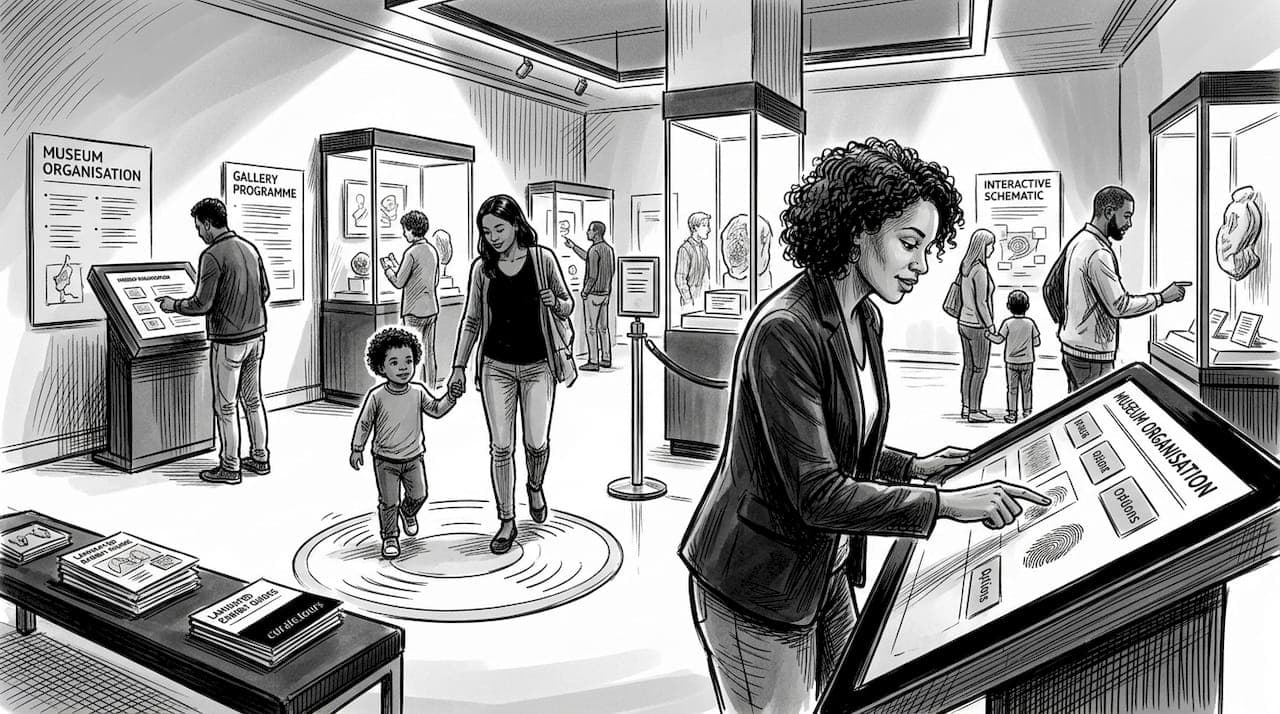
Interactive exhibitions are often misunderstood as merely flashy technology overlays on traditional displays. In reality, they represent visitor-responsive art experiences that fundamentally transform how audiences engage with creative works. For artists, curators, and gallery managers, these dynamic environments offer unprecedented opportunities to showcase collections through immersive 3D virtual exhibitions that respond to visitor inputs in real time. This guide clarifies what interactive exhibitions truly involve, explores the technologies and methodologies behind them, examines their benefits and challenges, and provides practical frameworks for creating compelling interactive experiences that elevate audience engagement beyond passive viewing.
Table of Contents
- Key Takeaways
- What is an interactive exhibition?
- Nuances and challenges in designing interactive exhibitions
- How curators create immersive 3D interactive exhibitions
- Benefits and impact of interactive exhibitions
- Bring your interactive exhibition ideas to life
- Frequently asked questions about interactive exhibitions
Key Takeaways
| Point | Details |
|---|---|
| Definition and core elements | Interactive exhibitions respond to visitor input using sensors, projections and software to create participatory experiences that replace passive viewing. |
| Technologies and methodologies | They combine sensors, projection mapping, VR and AR, with responsive software to shape live immersive exhibitions. |
| Audience benefits | Interactive formats boost engagement and accessibility by allowing personalised, participatory pathways through content. |
| Design tips for curators | Curators should start with simple interaction patterns and ensure intuitive entry points to minimise barriers to engagement. |
What is an interactive exhibition?
An interactive exhibition responds to visitor input such as touch, motion, voice, gesture, or presence, using sensors, projections, and software to create dynamic, participatory experiences that enhance engagement and learning beyond passive viewing. Unlike traditional static displays where visitors simply observe artefacts behind glass, interactive exhibitions establish a continuous feedback loop between the visitor and the artwork, transforming spectators into active participants who shape their own experience.
The input mechanisms vary considerably in sophistication. Touch-sensitive surfaces allow visitors to explore layered information about artworks, while motion sensors detect body movements to trigger visual or auditory responses. Voice recognition systems enable verbal queries about pieces, and gesture tracking interprets hand movements to manipulate virtual objects. Presence sensors detect when visitors approach specific zones, automatically activating contextual content that enriches their understanding of the work.
Core mechanics include sensors, projection mapping, responsive software, sound, and VR/AR for 3D immersive virtual spaces. Projection mapping transforms physical surfaces into dynamic canvases that respond to visitor behaviour, whilst spatial audio creates immersive soundscapes that shift based on movement patterns. Virtual and augmented reality technologies transport visitors into fully realised 3D virtual exhibitions where they can examine artworks from impossible angles or witness creative processes unfold in real time.
The fundamental difference between traditional and interactive exhibitions lies in participation. Traditional exhibits position visitors as observers who absorb information through text panels and visual inspection. Interactive exhibitions demand active engagement, inviting visitors to make choices, experiment with variables, and discover personalised pathways through content. This shift from passive consumption to active exploration fundamentally alters the relationship between artwork and audience, creating memorable experiences that resonate long after the visit concludes.
Pro tip: Start with simple interaction patterns like proximity-triggered audio before progressing to complex gesture controls. Visitors need intuitive entry points that don't require instructions or technical knowledge to begin engaging with your exhibition.
Nuances and challenges in designing interactive exhibitions
Designing effective interactive exhibitions requires navigating substantial technical and human factors challenges that can undermine even the most conceptually brilliant installations. Hardware reliability emerges as a persistent concern, with touchscreens, sensors, and projection systems subject to wear from constant visitor interaction. A single malfunctioning component can break the immersive spell, transforming an engaging experience into a frustrating encounter with technology failure.
Accessibility standards present another critical consideration. Hardware failures and accessibility compliance add complexity; careful design is needed to avoid motion sickness and cognitive overload. Exhibitions must meet WCAG 2.1 AA standards for digital interfaces and ADA compliance for physical installations, ensuring visitors with diverse abilities can fully participate. This means providing alternative input methods for those unable to use gesture controls, offering audio descriptions for visual content, and ensuring sufficient contrast ratios for visitors with visual impairments.
The touch versus no-touch dilemma creates particular tension for galleries handling valuable or fragile artefacts. Physical interaction enhances engagement but risks damage to irreplaceable works. Virtual alternatives eliminate this risk but may reduce the visceral connection visitors feel with authentic objects. Many institutions adopt hybrid approaches, offering high-resolution 3D scans for tactile exploration whilst preserving originals behind protective barriers.
Cognitive load management requires careful calibration. Overwhelming visitors with simultaneous sensory inputs, complex navigation schemes, or information-dense interfaces produces fatigue rather than engagement. VR experiences particularly risk inducing motion sickness if frame rates drop or movement mechanics feel unnatural. Successful interactive exhibitions balance stimulation with comprehension, providing clear wayfinding and allowing visitors to control pacing.
| Format | Strengths | Limitations |
|---|---|---|
| Physical interactive | Contextual understanding, authentic object presence, intuitive spatial navigation | Limited reach, maintenance intensive, accessibility barriers |
| Virtual 3D exhibition | Global accessibility, zero marginal distribution cost, safe artefact handling | Reduced physical presence without high interactivity, equipment requirements |
| Hybrid approach | Combines authenticity with extended reach, flexible engagement options | Complex coordination, higher development costs |
Physical interactives excel in contextual understanding; virtual 3D enhances global access but may lag in presence without high interactivity; multi-modal inputs increase inclusivity. Crowd behaviour adds unpredictability, with visitor queueing, unintended interactions, and social dynamics affecting individual experiences. Popular installations create bottlenecks that frustrate waiting visitors, whilst collaborative features may intimidate those preferring solitary exploration.
Pro tip: Implement graceful degradation strategies where core content remains accessible even if advanced interactive features fail. Your exhibition should never become completely unusable due to technical issues.
How curators create immersive 3D interactive exhibitions
The practical process of building interactive exhibitions has become remarkably accessible through no-code platforms that eliminate traditional technical barriers. Curators use no-code platforms like Artsteps and Kunstmatrix with drag-and-drop rooms, multimedia uploads, interactivity hotspots, and engagement analytics. These systems provide pre-built templates for gallery spaces, allowing curators to focus on content curation and visitor experience design rather than software engineering.
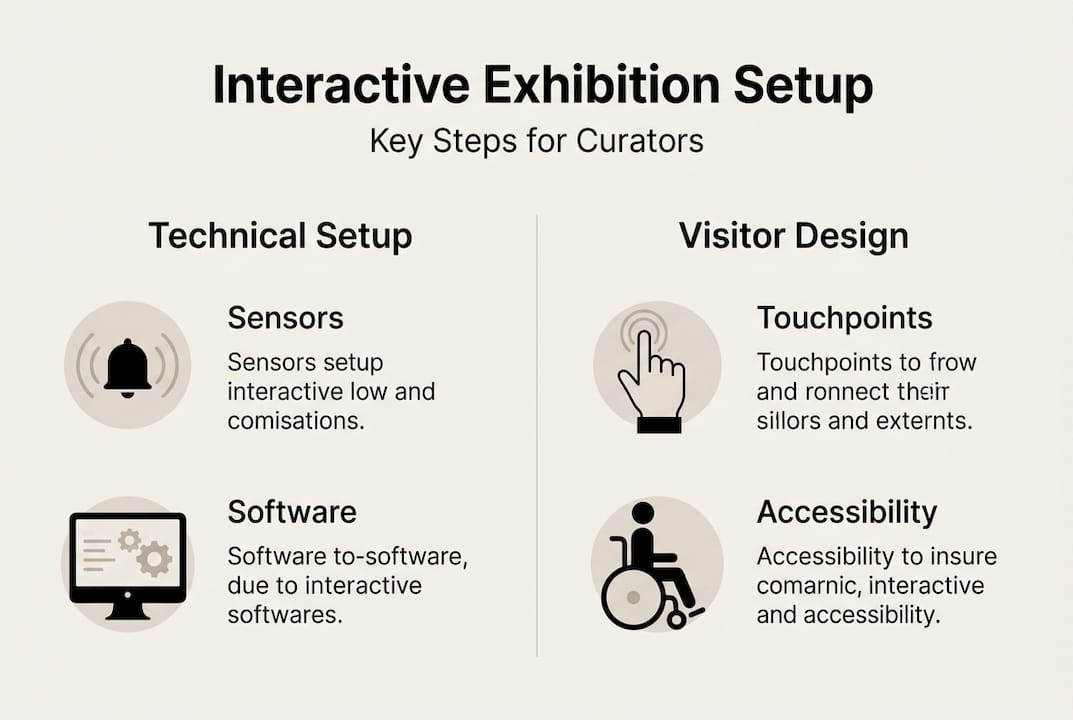
Modern platforms support diverse media formats essential for rich exhibitions. Standard image uploads accept JPEG and PNG files for two-dimensional artworks and photographic documentation. Video content via MP4 files enables dynamic storytelling and artist interviews. Three-dimensional objects require GLTF, GLB, or USDZ formats, allowing visitors to examine sculptures and installations from every angle. This format flexibility ensures curators can represent their collections authentically regardless of medium.
Interactive features transform static galleries into responsive environments. Hotspots overlay contextual information, artist statements, and multimedia content onto specific artworks, activating when visitors approach or select them. AR overlays superimpose digital elements onto physical spaces, enabling virtual sculptures to appear in real rooms or providing x-ray views into artwork construction. Avatar systems allow multiple visitors to explore 3D virtual exhibitions simultaneously, creating social experiences that mirror physical gallery visits.
The design process follows iterative phases that refine the visitor experience:
-
Planning and theme development establishes the exhibition narrative, selects artworks, and defines desired visitor outcomes. This phase identifies key messages and determines which interactive mechanisms best support learning objectives.
-
Prototyping and spatial layout creates initial room configurations, positions artworks strategically, and implements basic interactivity. Curators experiment with sightlines, pacing, and information density to optimise flow.
-
User testing with representative audiences reveals usability issues, confusing navigation, and technical problems before public launch. Observing real visitors exposes assumptions that seemed obvious during development.
-
Iteration and refinement addresses feedback systematically, adjusting interaction patterns, simplifying complex features, and enhancing successful elements. This phase continues post-launch as analytics reveal actual usage patterns.
| Metric | Purpose | Typical benchmark |
|---|---|---|
| Dwell time per artwork | Measures engagement depth | 45-90 seconds for interactive vs 15-30 for static |
| Hotspot activation rate | Indicates content discovery | 60-75% of visitors should engage |
| Completion rate | Shows exhibition flow effectiveness | 70-85% should reach final room |
| Return visitor percentage | Reflects lasting appeal | 15-25% for compelling exhibitions |
Analytics platforms track these engagement metrics automatically, providing curators with empirical evidence of what works. Dwell time measurements reveal which artworks captivate attention, whilst participation rates show whether interactive elements feel intuitive or confusing. Heat maps visualise visitor movement patterns, identifying bottlenecks and overlooked content.
Expert nuance: design emphasises prototyping and endurance testing; hybrid models and AI optimisation improve experience and adaptability. Artificial intelligence increasingly enhances exhibitions through personalised recommendations that adapt content to visitor interests, natural language processing for conversational interfaces, and computer vision that analyses visitor behaviour to optimise layouts dynamically. These technologies evolve exhibitions from static configurations into adaptive environments that improve continuously.
Pro tip: Schedule user testing sessions with visitors who match your target audience demographics but haven't seen your content before. Fresh eyes catch usability issues that become invisible to designers immersed in the project.
Benefits and impact of interactive exhibitions
Empirical research demonstrates that interactive exhibitions substantially outperform traditional formats across multiple engagement dimensions. Interactive installations produce 40%+ dwell time increases; mixed reality engagement averages 21.6 minutes versus lower for VR and VR360. This extended engagement translates directly into deeper learning, stronger emotional connections with artworks, and higher likelihood of return visits.
The modality of interaction significantly influences outcomes. Mixed reality experiences that blend physical and virtual elements achieve the longest engagement durations, averaging over 21 minutes per visitor. Pure VR installations generate moderate engagement but risk isolating visitors from social interaction. VR360 experiences, whilst immersive, often produce shorter sessions as passive observation limits active participation. Physical interactive installations excel at immediate comprehension but constrain reach to those who can visit in person.
Learning outcomes vary by exhibition format in nuanced ways. Physical interactive installations produce superior contextual understanding because authentic objects carry cultural weight and spatial relationships that virtual representations struggle to replicate. However, virtual 3D virtual exhibitions dramatically expand reach, enabling global audiences to access collections previously limited by geography and eliminating capacity constraints that plague popular physical venues.
"Interactive exhibitions transform visitors from passive observers into active participants, creating memorable experiences that enhance learning retention by up to 60% compared to traditional static displays."
Interactivity enhances presence, immersion, satisfaction, and ROI via increased revenue and memberships. Visitor satisfaction scores consistently rank interactive exhibitions higher than traditional formats, with post-visit surveys revealing stronger emotional responses and greater likelihood to recommend the experience to others. This word-of-mouth amplification extends marketing reach organically.
Financial considerations shape implementation decisions significantly. Budget ranges vary by complexity and scale:
- Simple touchscreen stations with basic multimedia content: £15,000-£30,000
- Mid-range installations with projection mapping and sensor arrays: £40,000-£80,000
- Room-scale immersive environments with VR/AR integration: £100,000-£150,000+
- Virtual-only exhibitions using no-code platforms: £2,000-£10,000
Return on investment manifests through multiple channels. Increased ticket sales from enhanced visitor satisfaction provide direct revenue growth. Membership conversions rise as compelling experiences motivate visitors to maintain ongoing relationships with institutions. Corporate sponsorships become more attractive when exhibitions generate measurable engagement metrics that demonstrate audience reach. Educational programmes benefit from interactive elements that make complex concepts accessible, justifying grant funding and institutional support.
The accessibility benefits extend beyond physical reach to cognitive inclusion. Multi-modal inputs allow visitors with diverse learning preferences to engage through their strongest channels, whether visual, auditory, or kinaesthetic. Customisable difficulty levels enable both casual visitors and domain experts to find appropriate challenge levels. Language options eliminate barriers for international audiences, whilst adjustable pacing accommodates visitors who need additional processing time.
Pro tip: Calculate ROI holistically by including increased memberships, educational programme enrolment, and donor cultivation opportunities rather than focusing solely on ticket revenue. Interactive exhibitions generate value across multiple institutional objectives simultaneously.
Bring your interactive exhibition ideas to life
Transforming your exhibition concepts into immersive realities no longer requires extensive technical expertise or prohibitive budgets. curate.tours offers a no-code platform specifically designed for artists, curators, and gallery managers who want to create engaging 3D virtual exhibitions without wrestling with complex software or hiring development teams. The browser-based system lets you design customisable gallery spaces, upload diverse media formats, and implement interactive hotspots that respond to visitor behaviour, all through intuitive drag-and-drop interfaces.
The platform includes built-in analytics that track visitor engagement metrics, revealing which artworks capture attention and how audiences navigate your exhibition spaces. These insights enable continuous refinement, helping you optimise layouts and interaction patterns based on actual visitor behaviour rather than assumptions. Whether you're showcasing a solo artist's portfolio, curating a thematic group exhibition, or building a permanent virtual collection, the tools provide flexibility to realise your creative vision whilst maintaining professional presentation standards that reflect well on your brand.
Frequently asked questions about interactive exhibitions
What technologies power interactive exhibitions?
Interactive exhibitions utilise sensor arrays for detecting touch, motion, and presence, projection mapping systems for responsive visuals, spatial audio for immersive soundscapes, and VR/AR platforms for three-dimensional experiences. Software layers interpret visitor inputs and trigger appropriate responses, creating the feedback loop that defines interactivity.
How can I measure visitor engagement in virtual galleries?
Analytics platforms track dwell time per artwork, hotspot activation rates, navigation pathways, and completion percentages. Heat maps visualise where visitors spend time, whilst session recordings reveal interaction patterns. These metrics help curators identify successful elements and areas needing improvement in 3D virtual exhibitions.
What accessibility standards should I consider?
Your exhibition should meet WCAG 2.1 AA standards for digital interfaces, ensuring sufficient colour contrast, keyboard navigation, and screen reader compatibility. Physical installations must comply with ADA requirements for wheelchair access and provide alternative input methods for visitors unable to use standard controls.
Can I create an interactive exhibition without coding?
Yes, no-code platforms like curate.tours enable complete exhibition development through visual interfaces. You can design gallery spaces, upload artworks, implement interactive features, and publish globally accessible exhibitions without writing any code. These tools democratise exhibition creation for curators focused on content rather than technology.
What are typical costs involved in interactive displays?
Virtual-only exhibitions using no-code platforms range from £2,000-£10,000, whilst physical touchscreen installations cost £15,000-£30,000. Mid-range projection mapping systems require £40,000-£80,000, and room-scale immersive environments with VR integration exceed £100,000. Budget allocation depends on exhibition scope, duration, and desired interactivity complexity.